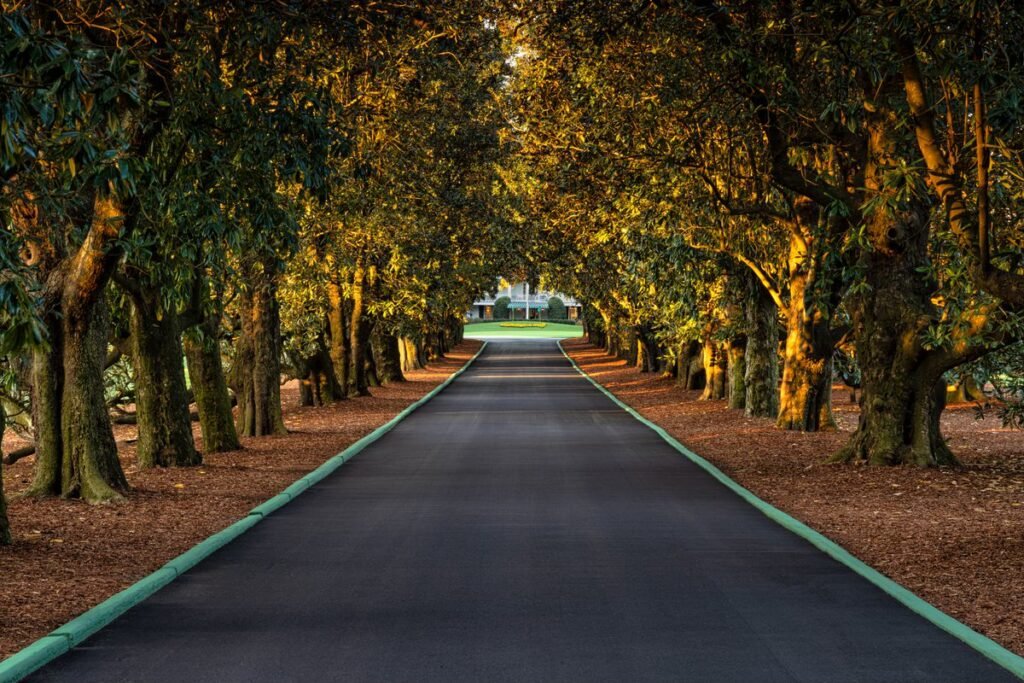
Rory McIlroy wins The Masters – Completes Career Grand Slam
On August 10, 2014 Rory McIlroy exited Valhalla Golf Club in Louisville with the Wanamaker Trophy and world of golf in the palm of his hand. He had just captured his fourth major, his second consecutive major of the year, and his third straight victory overall. At only 25 years old, it felt inevitable that he’d win many more majors in short order and take over as the sport’s dominant figure in the post-Tiger era. The following April he would head to The Masters for his first opportunity to become only the sixth player ever to complete the career grand slam. For a player who had all the power, talent, and a high right-to-left ball flight seemingly tailor-made for Augusta National Golf Club, it didn’t feel like a matter of if he’d win The Masters- but when and how many times. But as golf and life so often remind us, nothing is ever guaranteed.
While entire books could be written on all the ups and downs of Rory’s last 10 years and 249 days, each day this week felt like an epic in its own right – all culminating in one of the greatest shows golf and sports has ever seen on Sunday afternoon.
Thursday Rory looked to be in full control of his game and seemed poised to possibly grab control of the tournament. Standing in the 15th fairway, iron in hand, and at 4-under par only three shots back of tournament leader Justin Rose, he fired a rocket of a long iron that carried the water landing pin-high and bounding just over the back of the green. As Patrick Cantlay had demonstrated minutes earlier it was going to be a delicate shot but certainly not impossible for a player of McIlroy’s caliber. But over the next 45 minutes everything unraveled. He chipped the ball into the water on the 15th leading to a crushing double bogey, and made another inexplicable double bogey on 17. What could have been a statement round turned into a deflating even-par 72.
In just three holes, Rory had gone from looking to potentially be at or near the lead going into Friday to starting his second round seven shots back and completely deflated. “Same old Rory” many fans said. All the hype – all of the promise – only to unravel when it mattered most.
If the “same old Rory” of the last decade is what people expected – then Friday and Saturday delivered the version we have all been waiting for – the Rory that played to his talent and met our sky-high expectations of him. On Friday, he fired a bogey-free 66, fueled by birdies on 10, 11, and an eagle on 13. Saturday he came out red-hot, setting a tournament record with six straight 3’s, including an amazing chip in for eagle on the second hole.
After a few stumbles in the middle of his round, Rory then delivered what was then the signature shot of the tournament with a towering iron shot into the par-5 15th hole setting up another eagle. He ended the day at 12-under par and with a two-shot lead.
Just 18 holes stood between Rory McIlroy and history – the career grand slam. But his Sunday playing partner, Bryson DeChambeau, was not going to make it easy – and also seemed to have the mental advantage. Like it or not, Rory was carrying 14 years of baggage with him after his Sunday second nine collapse in 2011, almost 11 years without a major, and countless heartbreaks. The most recent heartbreak, and arguably the most gut wrenching, coming at the hands of DeChambeau last June at Pinehurst No. 2 in the US Open. Everything in our hearts seemed to point to this being Rory’s time. But our heads, scarred from years of letdowns and close calls, weren’t so sure. Layer in the additional drama and bad blood of the PGA Tour vs LIV Golf debate, the stage was set for either the crowning achievement of his career, or another crushing defeat.
For any fan rooting for McIlroy, Sunday could not have started out any worse. Rory opened with another disastrous double bogey on hole 1, his 3rd of the tournament. By the time he walked off the 2nd green, his two-shot lead suddenly became a one-shot deficit. It felt like the wheels were coming off. Again. On a Sunday. Against Bryson DeChambeau.
But Rory steadied the ship. He followed up with impressive birdies on 3 and 4, while Bryson continuing to fight his ball striking faltered with two bogeys. Even when Rory found trouble off the tee, he flashed his raw talent and shot-making ability with incredible recovery shots from the trees on holes 5 and 7. With a birdie on 9 and a four-shot lead, the stage was set for one of the greatest Sunday second nines of all time.
As the old saying goes on the broadcasts, “The Masters doesn’t begin until the second nine on Sunday” – and yesterday, it could not have been more true.
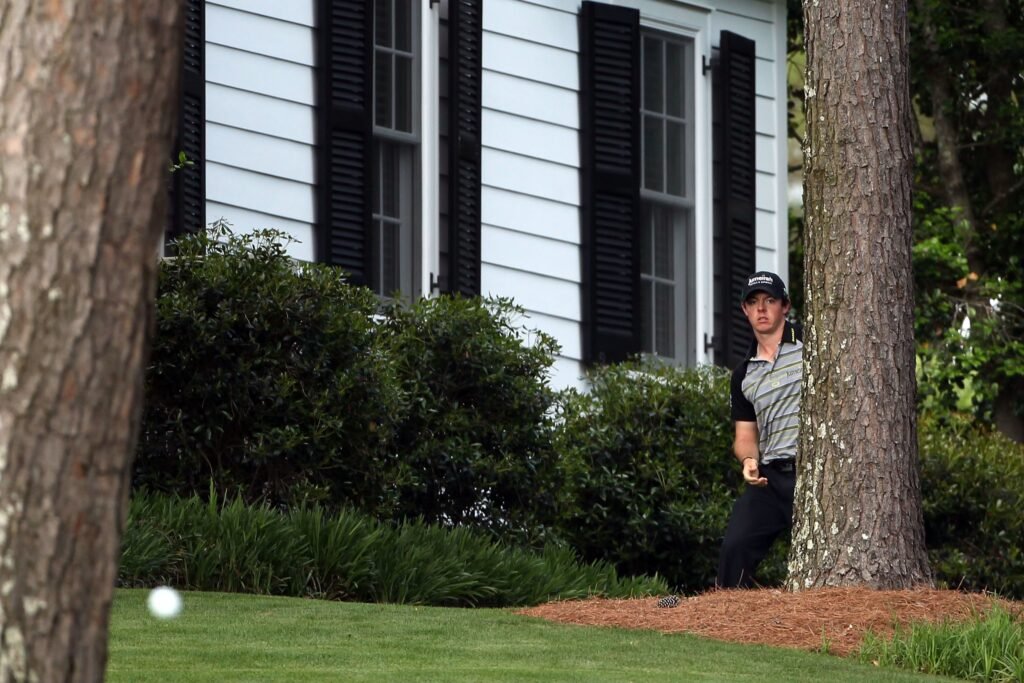
Nobody wanted to say it, but as Rory stepped onto the tee at 10 we all thought about 2011. The duck hook tee shot that landed among the cabins, leading to a triple bogey 7 that began his infamous spiral. Patrons on the grounds and fans watching on TV around the world all held our breath. But we could have saved holding our breath for later as Rory played two beautiful shots and made another birdie. He went to 11 still holding on to a four-shot lead even as Justin Rose charged through Amen Corner with three birdies.
Hole 11 is where things started to get interesting, as the leaders entered into the heart of the famous Amen Corner. After Bryson put his second shot into the water – effectively ending his hopes of a green jacket, Rory gave us our first real scare. His punch-out from the trees caught the slopes short of the green and stopped just inches shy of rolling into the same pond that had claimed Bryson’s ball, just as it had claimed the dreams of so many aspiring champions through the years. Rory would escape with a bogey, but it still felt like the largest crisis had been averted on the second shot.
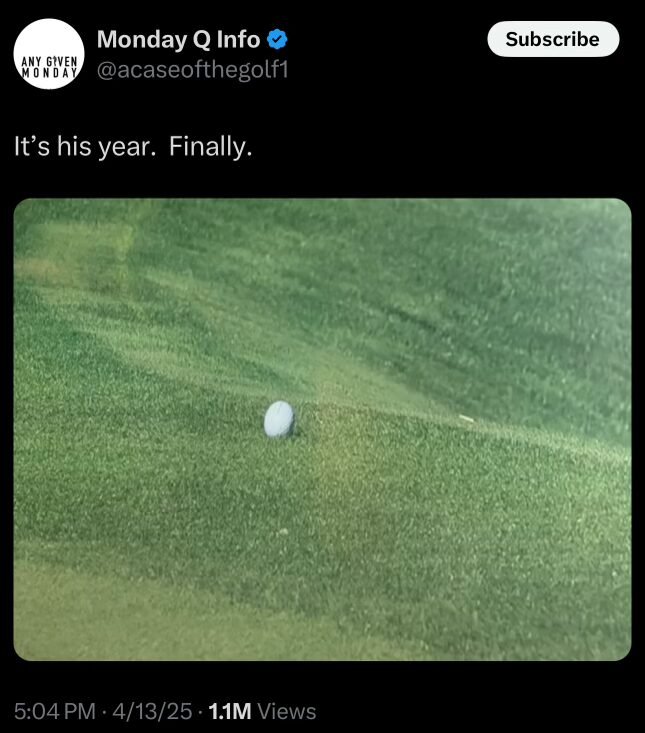
Mcilroy played the iconic but treacherous hole 12 flawlessly playing to the center of the green, a disciplined approach long echoed by past champions Jack Nicklaus and Tiger Woods. Rory walked off with a stress-free par, while ahead of him, Rose faltered at hole 14 with a bogey to restore Mcilroy’s four-shot lead.
After two solid shots on 13, the real drama would begin. A seemingly straightforward pitch shot into the 13th green was inexplicably blocked right into the tributary guarding the right side of the green. It felt like all the oxygen had been let out. Rory had just surrendered his fourth double bogey of the week- his second on a par 5. His four-shot lead on the 13th tee had evaporated in minutes, as Justin made clutch comeback birdies on the 15th and 16th to move into a share of the lead at 11 under par.
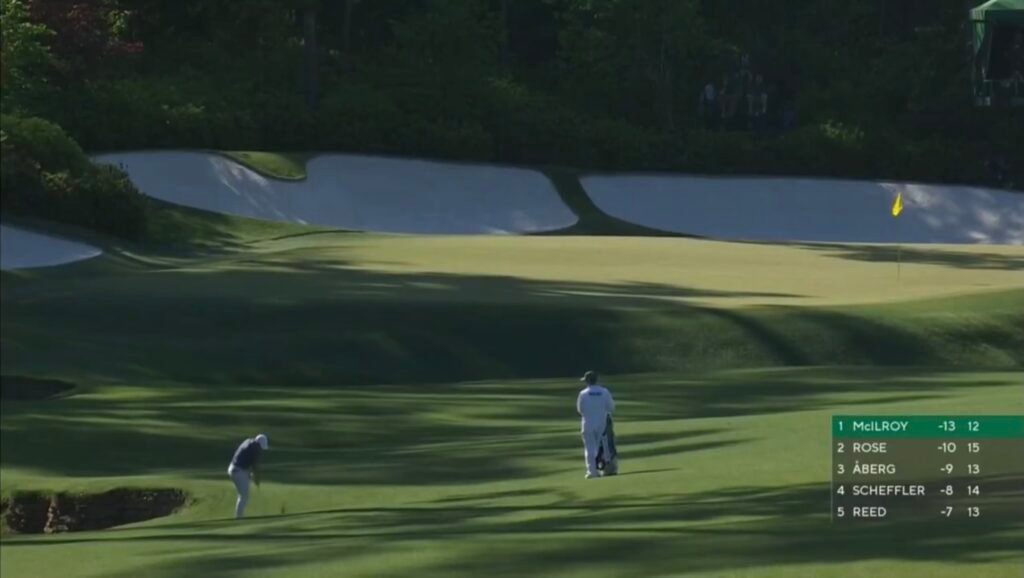
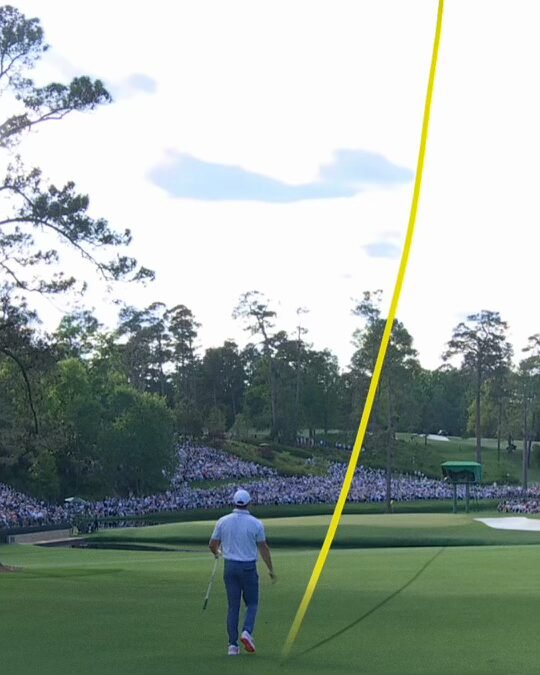
A poor tee shot on 14 resulted in another bogey, and suddenly Rory found himself one shot behind Justin Rose. If hole 13 had let all the air out of Rory’s sails, hole 14 had turned the heat up to near-boiling.
Despite another bogey on 17, Justin Rose finished the round with a huge birdie putt on 18 to set the lead in the clubhouse at 11-under par after an impressive round of 6-under par 66 with 10 birdies. Young phenom Ludvig Åberg was still in contention with a couple holes to play. Even players once thought to be out of contention like 2018 champion Patrick Reed and Bryson DeChambeau, had been given new life by McIlroy’s missteps. As Rory McIlroy stepped onto the tee at 15, it was clear this tournament was far from over.
Rory once again showed off his raw power and talent with a massive 7-iron slinging draw, with his ball coming to rest inside 10 feet for another eagle. But a shaky putt led to just a birdie.
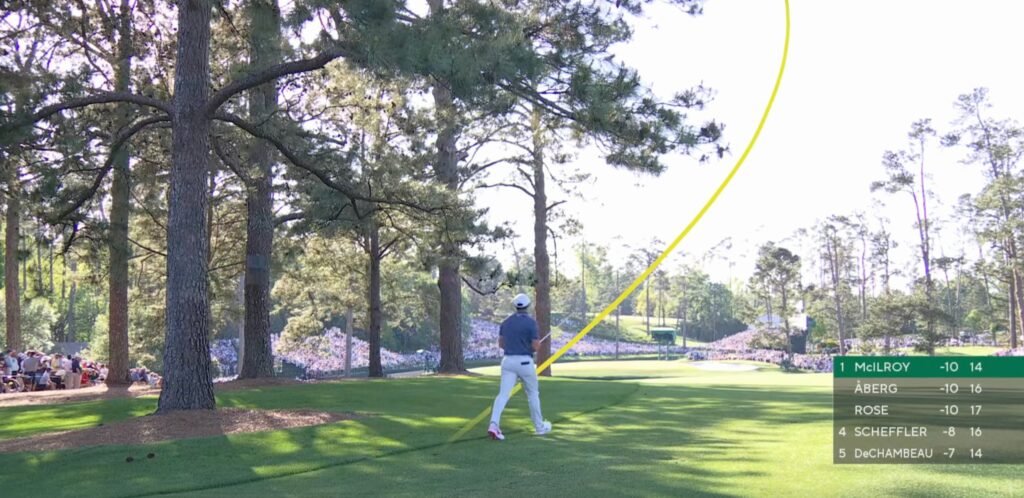
An impressive iron shot into the back right pin at 16 led to a birdie opportunity but another tentative putt yielded just a par. On 17, Rory unleashed yet another towering 8-iron to inside 5 feet from the hole. Rory retook the lead at 12-under par walking to the tee on the 72nd hole. All he needed was one par to avoid a playoff with Justin Rose.
It seemed that McIlroy had it all under control after a beautiful drive navigated the tight chute of trees on the 18th hole finding the fairway with less than 130 yards to the traditional front-left Sunday hole location. Everyone was thinking the same thing: “Just one more good iron shot, Rory, Just put it on the center of the green”.
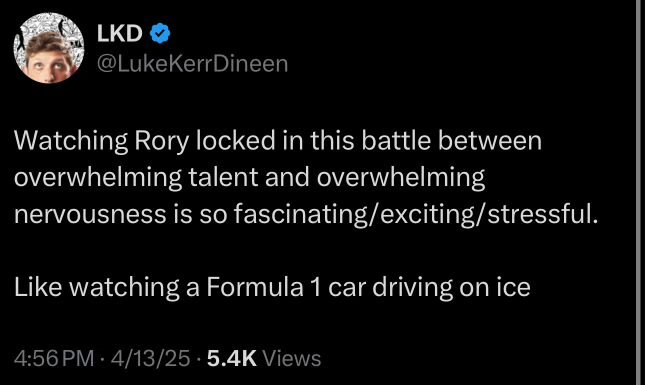
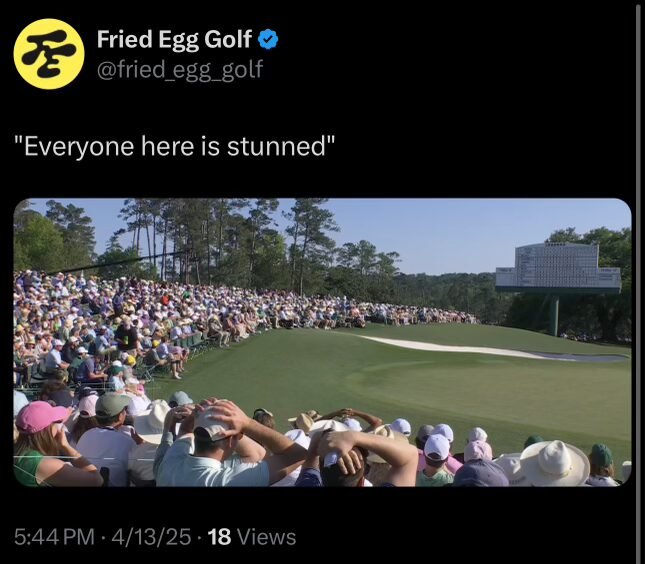
But once again the evening took a dramatic twist when he hit another poor wedge shot that found the right greenside bunker. The expected serenade of cheers and standing ovations as he walked up the hill on 18 was instead filled with hopeful but anxious applause from the patrons. A solid bunker shot rolled up onto the green stopping about 5 feet from the hole and left him with a putt to win – The Masters and the grand slam both on the line. But, much like the final putt at Pinehurst last summer, it never even touched the hole. We were heading to a playoff- the first at Augusta since Justin Rose fell short against Sergio Garcia in 2017.
Rory’s walk to scoring must have been one of the loneliest walks of his life. Thousands of patrons had gathered all around 18 green in anticipation of witnessing history, chanting “RORY! RORY!”. Instead of the usual celebratory roar, there was an uncomfortable murmur as patrons wondered: if not now… when?
The pair returned to the 18th tee for a sudden death playoff, and both hit perfect tee shots. Rose put his approach shot in close, but Rory two yards closer than his previous wedge shot into 18, stuck it inside 3 feet from the hole. Rose would narrowly miss his birdie putt clearing the stage for Rory. A normal putt of this length would be routine for any professional but this was no routine circumstance.
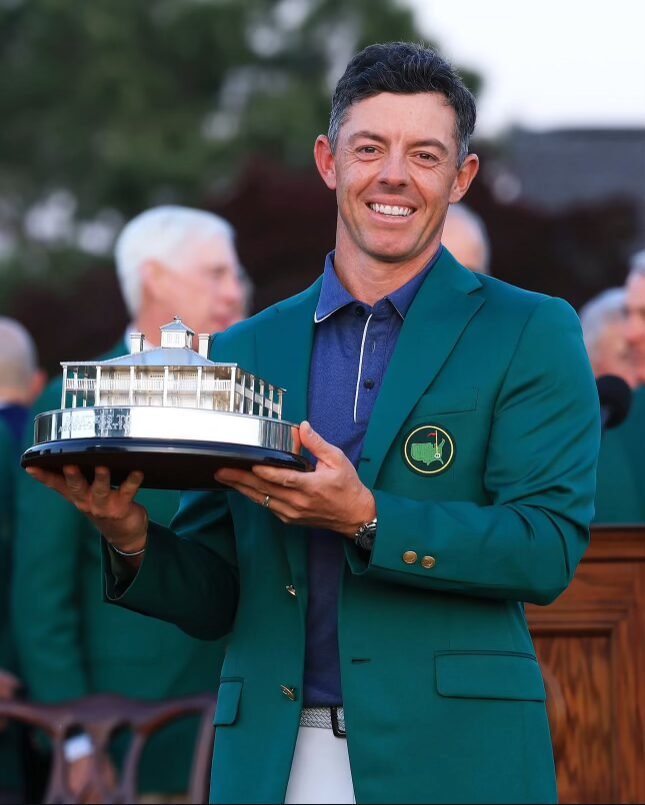
Rory made the putt, the patrons erupted in cheers, and he collapsed to his knees in a scene of raw emotion. You could feel the weight of the last decade pouring out of him. It wasn’t just a victory – it was a release. This meant everything to him.
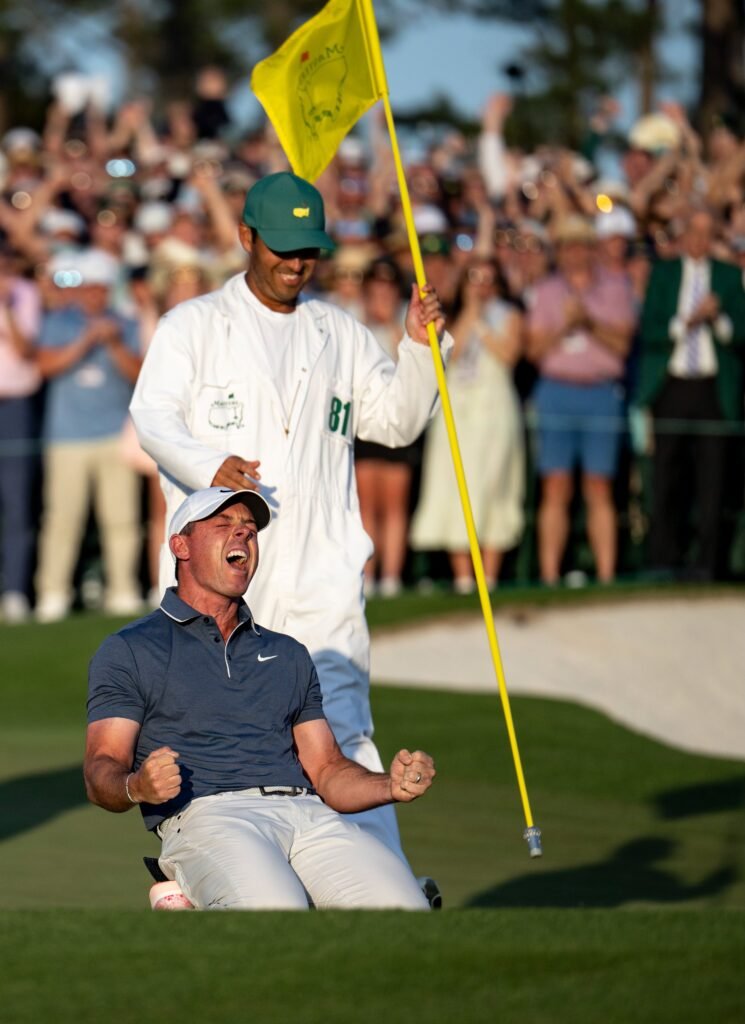
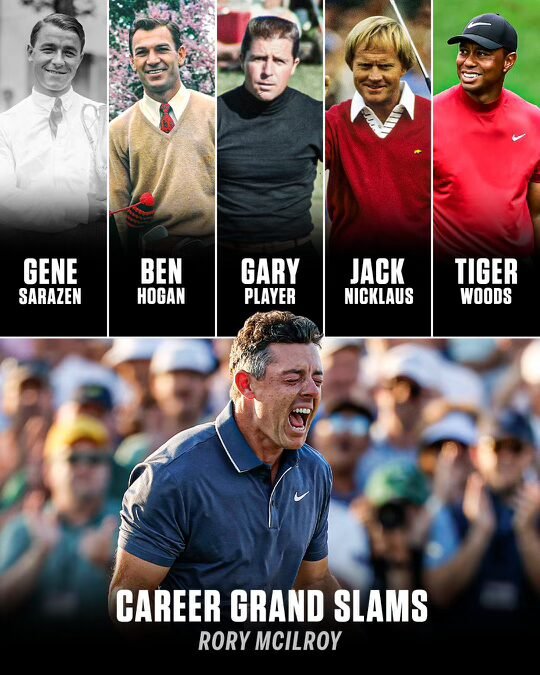
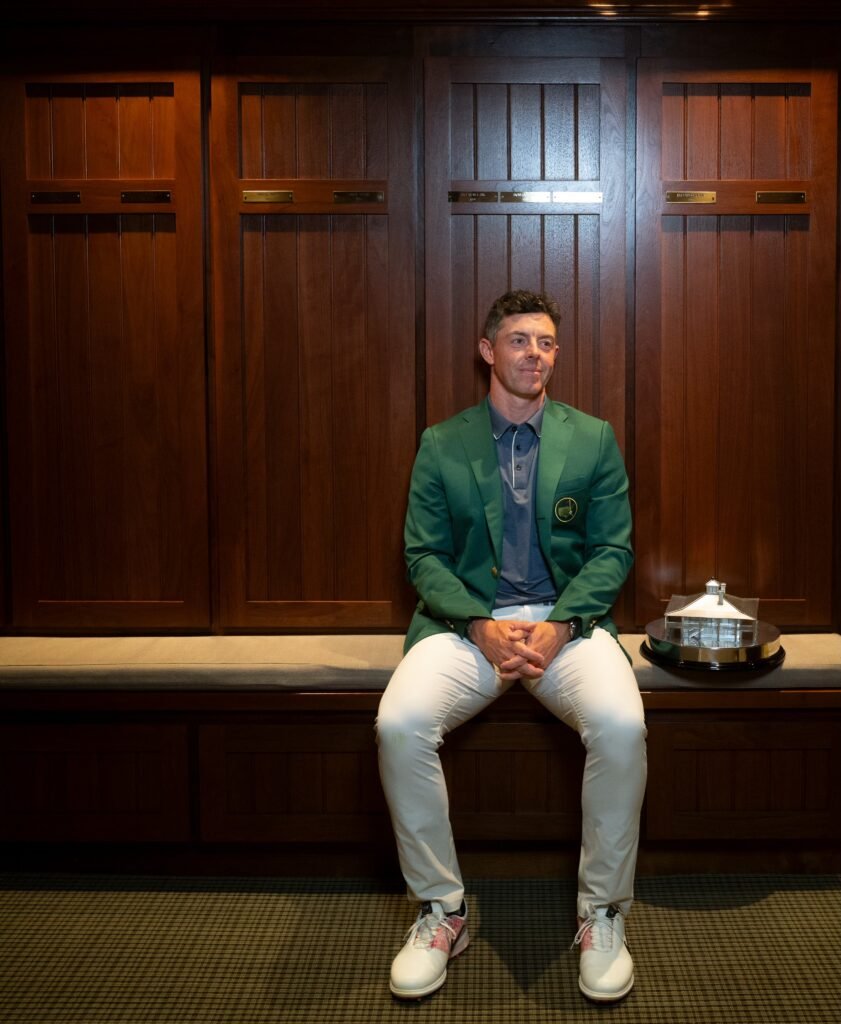
He had finally done it. He had slayed the demons of his past and stepped into rarified air among the legends of the sport – completing the modern grand slam alongside Gene Sarazen, Ben Hogan, Jack Nicklaus, Gary Player, and Tiger Woods. Of that elite group, nobody had ever taken more than three attempts at completing the slam. Sarazen, Hogan, and Tiger all did it on their first attempts. Nicklaus and Player took three. Rory Mcilroy did it after 11 long years of agony and frustration – close calls and missed cuts alike. Last year’s champion, Scottie Scheffler, slipped the green jacket onto his shoulders, and with it a lifetime invitation to compete in The Masters.
Through his career Rory had always proven to be a prolific talent and frequent winner on tour – especially when his game has been firing at all cylinders. But what we hadn’t always seen was his ability to dig deep when his back was against the wall, and find a way to win. He made an astonishing four double bogeys during the week, surpassing Craig Stadler’s three double bogeys when he captured the green jacket in 1982. The only recent comparison was Tiger Woods, who also made three double bogeys on the first hole en route to his iconic win in the 2008 US Open at Torrey Pines. It wasn’t always pretty – but major championship golf isn’t supposed to be. Majors are meant to be tournaments that push players to their breaking points, to separate the good players from the great.
While it was easy to get caught up in the emotional swings of every shot, I felt it was just as important to take a step back and appreciate the moment – and the stage it was unfolding on. Dr. Alister Mackenzie’s masterpiece under the magnolias once again serving as the theater for a drama only The Masters can produce, year after year. Watching the patrons reacting in real time to the changes in the leaderboards revealed another layer of what makes Augusta so magical. In an age when any other tournament or sporting event has up to the second scoring available through our cellphones or giant LED scoreboards, we’ve lost sight of what it means to live and die in the present. But at Augusta, the slow and deliberate unveiling of the manual scoreboards turns every number into its own drama. The patrons collectively holding their breath as the leaderboard plaques would open, exploding in cheers with every birdie or gasps of agony at any bogey is something that you only see at The Masters.
In the press center wearing his newly awarded green jacket, Rory talked about what he would tell his younger self in 2011—after shooting a final-round 80 when he entered Sunday with a four-shot lead. He spoke about a young version of himself who probably didn’t know how or why he ended up in that position, and how much he has grown and matured since then, both as a person and a professional golfer.
It felt like an appropriate time to reflect on our own journeys since then. I was 15 years old and a high school freshman when Rory lost that 2011 Masters. When he last won a major in 2014, I was 18 years old—just two weeks away from leaving home for college for the first time. Now I’m 29, in my second job after college, and still often searching for what it is I want to do in this life. It made me wonder: what would I say to the younger version of myself from that same time? What have I learned? What have I overcome? What remains unfinished?
To paraphrase Wright Thompson’s Thursday vignette for ESPN: every April when we return to Augusta, we return to a familiar place. A place to reconnect with old friends—or make new ones. A place where we get the chance to meet old versions of ourselves. A comforting place to take stock of all the changes in our lives and the world around us, and to ponder the direction we’re heading.
If Rory’s message to his 21-year-old self would be to stick with it and never give up, I think we’d all do well to borrow that advice. We may not be trying to make history or end an 11-year major championship drought in front of thousands of patrons and millions of viewers, but each of us carries our own baggage. We all face personal demons that must be slayed to create the life we dream of.
There will be plenty of time to debate Rory’s legacy, where this tournament ranks in the pantheon of Masters and major championship history, and what the future might hold. But for now, it’s important to just sit back, take a deep breath, and be thankful we got to witness it.
Next April, we’ll reconvene once again in Augusta, Georgia for the 90th playing of The Masters. Rory will have his seat at the Tuesday night Champions Dinner. We’ll see the familiar sights of Augusta National and take in another chapter of Masters history. The echos of past Masters Tournaments whispering through the tops of the loblolly pines. And once again, we’ll be given the opportunity to take stock of our own lives—against the backdrop of the grandest scene in sports.
From a 21-year-old with unlimited talent experiencing his first heartbreak in 2011, to a 35-year-old husband, father, and now Masters Champion in 2025—Rory McIlroy reminded us that nothing worth having comes easy. And that greatness, while delayed, can still arrive right on time.
Until next April, Augusta National. Thank you for yet another classic chapter in your storied book of history. Truly, a Tradition Unlike Any Other.